Now that the Bears’ journey in the playoffs is over, after one very improbable touchdown and one heartbreaking interception, it’s time to think more calmly about the future of the Bears in Illinois, and, more importantly, it’s time to move beyond the stalled debate about the proposed PILOT legislation. The bottom line is that this particular proposal is irresponsible and unfair — but we still need to address the bigger picture of whether (and why) property taxes may indeed by unfairly high for a proposed stadium, and what to do about it, in a way that attempts to problem-solve rather than just give away tax breaks. So please bear with me for a longer explanation.
Last Friday, Arlington Heights Mayor Jim Tinaglia gathered local politicians and community leaders for a press conference to call on Gov. Pritzker and the state legislature to take action to ensure the Bears do not leave the state. The governor has already voiced his willingness to support infrastructure costs, but the Bears and local civic leaders and legislators alike insist that this isn’t enough, and that the only way the Bears can or will stay in Illinois is if the legislature passes the “Megaprojects” bill that’s stalled in the legislature, which would enable Arlington Heights to set a property tax level that’s substantially lower than the assessor would otherwise determine.
As it turns out, there is no single “Megaprojects” bill that’s making its way through committee. There are two bills in the House, HB4058 and HB2789 (the latter being sponsored by Canty and Grasse), as well as SB1514 in the State Senate (sponsored by Walker), and none of them have made it through any part of the committee process, so it seems fair to say that whatever might pass, would be hammered out behind closed doors and may or may not resemble any of these bills except in the basic structure: allow new projects meeting a minimum dollar amount (the bills vary in whether it’s $100 or $500 million in spending on construction or other costs) to get fixed and reduced property taxes for a period of up to 40 years. It’s anyone’s guess how the other differences between the bills would be worked out, for example, one has a 20% minority contractor requirement, and there are differences in whether individual local taxing bodies can veto the agreement or not. Perhaps there would be entirely unforeseen provisions in the final version.
However, one important provision that appears to be the same among all the bills is that there is no requirement that the project be entirely new. A company relocating from outside of Illinois or from one town to another appears to qualify, which, of course, is necessary for the Bears to move their stadium from Chicago to Arlington Heights and be eligible.
But without even bringing the Bears into the discussion, this bill goes against all of the principles I’ve outlined on my home page. It abandons fiscal responsibility, if not at the state level then locally, all the more so as it sets the stage for a relentless process of municipalities luring businesses by competing to offer “payments in lieu of taxes” that are more favorable than their neighbors. It picks winners and losers rather than working towards organic economic growth. And it’s fundamentally not fair: not only is it unfair that mega-businesses would pay proportionately less in property tax than small businesses, but it’s also likely that even among qualifying mega-projects, some businesses would receive more favorable terms than others.
However, having said that, it is necessary to address the key issue identified by the village, as put forward by Mark Batinick in his white paper: there is a more fundamental problem with Illinois’ property taxes.
Batinick doesn’t mince words:
A new stadium, he writes, “is stalled by Cook County’s property tax system, which — as currently structured — makes a modern, privately financed NFL stadium economically impossible.”
According to Batinick, commercial property in Arlington Heights is taxed at an effective tax rate of 7%. Applied to the estimated value of $3 billion of the “stadium and entertainment district” (presumably excluding the planned mixed-use area to the east), that’s $210 million. That’s far higher than other stadiums, such as LA’s SoFi Stadium, taxed at about $8.1 million. With respect to Chicago’s facilities, such as Wrigley Field and the United Center, “none are taxed anywhere near Cook County’s full commercial rate. If they were, none would exist.”
Is Batinick right? I can’t independently confirm his effective tax rate estimate, and he doesn’t provide a source. A 2022 Civic Federation report calculated a rate of 5.60% for commercial property in Arlington Heights, definitely higher than Chicago’s 4.29% but not 7%, though 2022 is now four years ago and it’s at least credible that the rate might have increased, in which case, for a business to pay 7% of the value of its property, year after year, is a pretty heavy burden.
Is the $3 billion estimate right? The dollar amounts of expenditure that have been reported also have generally been split out as $2 billion for the stadium and $3 billion for remainder of the full development (that is, including the “entertainment” elements and the mixed-use area). It appears that Batinick is combining the “entertainment” part of the development with the stadium, to get to the $3 billion cost, and the slide on the village’s website might be excluding this when it pares the projected property tax down to the range of $100 – $200 million.
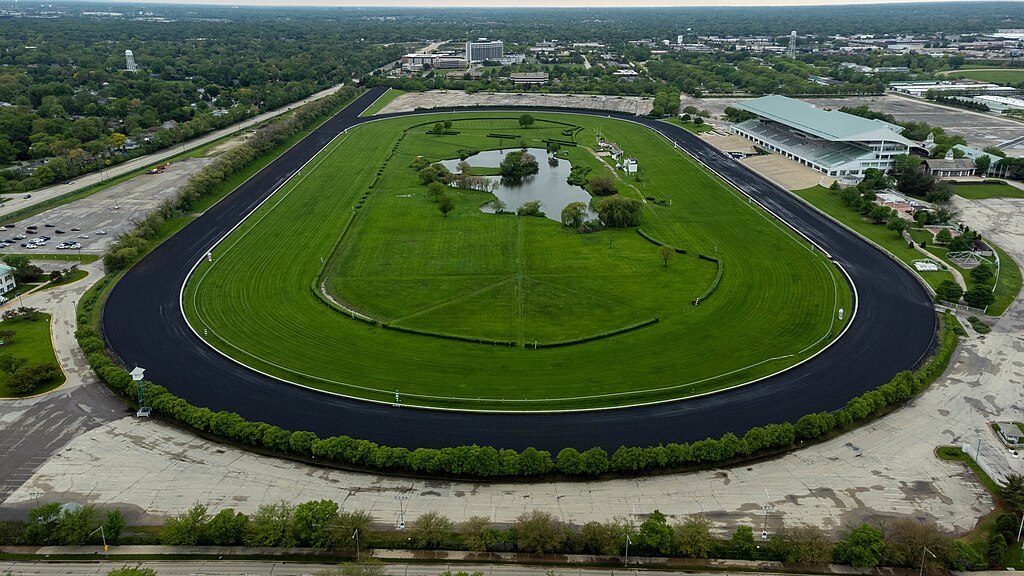
But here’s the wrinkle: to the best of my understanding, neither the United Center nor the racetrack when it existed have/had any special tax breaks, and Wrigley’s tax reductions are due to its historical landmark status.
Which gets us to the bottom line: if our property taxes are too high for even a high-revenue NFL team to turn a profit, then
- either our property taxes in suburban Chicago are too, high, period,
- or the system of determining a property’s “value” is broken and not just the Bears but many businesses with high-value property, on paper, are actually being unfairly overtaxed.
After all, an NFL stadium is not a typical building with an easily calculated market value. When the Bears decide to leave for greener pastures, whether it’s 20 or 50 years from now, the building will inevitably be demolished rather than re-used, so the tax assessment wouldn’t, and can’t be based on the market value of the property in the way my home or yours is.
And indeed part of the reason the United Center’s taxes are comparatively low is that it’s not based on a market valuation of the property but a “cost approach” — calculating the “replacement cost” of the building and then applying a depreciation factor, in this case, a 40% reduction. In the case of the Bears’ stadium, based on current law, presumably the same math would apply except that when it’s first built, there would be no depreciation factor at all.
And you could make a strong case that this method is fundamentally unfair. If the Bears overspend and throw in luxury features that don’t actually increase revenue but merely give them more prestige (or have no good reason at all but faulty decisions), or if economic conditions cause the “building cost” to swing drastically with no relationship to the team’s revenue, then even the cost approach might overstate the property taxes well beyond what would strike anyone using common sense as fair and reasonable. Plus, the depreciation method would mean that property taxes would be particularly punishing at the beginning of the “life cycle” of a stadium and then go down over time. How is this fair? Isn’t it to everyone’s benefit, both the property owner and the government, for taxes to be stable over time? (Consider, too, that if a PILOT system were instituted, it would mean that the property taxes collected by governments after the PILOT period expired, even if the stadium isn’t abandoned as obsolete, would be far lower than they would have been earlier, so the community never collects the “full” property taxes).
And the Bears wouldn’t just pay property taxes — they would pay sales tax, use tax, amusement tax, parking tax and (to the extent that they maintain ownership over more than just the stadium), hotel tax. Right now, a part of the Bears’ (implicit) pitch for economic benefit to the community is that these revenues would be so significant that property tax revenue could be sacrificed to ensure the viability of the project. But it’s far more appropriate to look at whether any of these other taxes are too high rather than playing a shell game to compensate for them.
After all, it’s not just the Bears who lament property taxes. Locally, the owner of Tuscan Market in downtown Arlington Heights recently posted a gofundme request, and explained that a sharp increase in property taxes led to escalating rent. A few days ago, the Sun Times reported that Mama Africa’s Marketplace on Chicago’s south side was closing because the building’s owner was forced to sell due to the dramatic property tax increase when the bill came in December.
So what’s the bottom line?
Instead of the PILOT program, we need a systematic review of the system of assessing property taxes for not just sports venues but all non-standard properties which are at risk of being unfairly taxed, so as to ensure that taxation is fair, rather than giving tax breaks to just some of those affected businesses.
And we need to redouble our efforts to reduce or at least slow local government spending relative to inflation to reduce the property tax burden we all face.