I’ll be honest: for a long time, I thought complaints about tolls were silly. Paying tolls is just a part of what’s needed to have a well-maintained highway system, right? Not so fast! The more I looked into the latest shenanigans around the toll hikes, the more problems I saw.
First of all, the Illinois Tollway officially operates independently of the state, but the politics? They’re just as corrupted as the rest of it. If you haven’t been following the news closely: in the October 2025 veto session, when the Democrats (including all our local State House and Senate Democrats) passed their massive Transit bill, they got the unions to accept the siphoning off of road fund money to be used for transit, by adding to the bill a toll hike – not because tolls would replace the siphoned-off money but because jobs from construction projects on tollways would replace jobs from construction projects on other Illinois interstates, which will now have their roadwork delayed. (This isn’t speculative – it was widely reported at the time.)
At the time, the Tollway Board claimed that only they, and not the legislature, had the power to increase tolls. And now, a little under a year later, lo-and-behold, on August 19, they have decided, as if by magic, to raise tolls by the exact amount of the transit law: a hike of 57% for cars as of January 1st, and permanently locked-in CPI increases after that.
This is not independence.
Even worse, it turns out that state law does not permit the Board to pick whatever rate they choose (let alone have that rate be dictated by the state legislature) and then choose as many construction projects as they can fund with that toll rate. State law specifies instead precisely the opposite:
Such tolls shall be so fixed and adjusted at rates calculated to provide the lowest reasonable toll rates that will provide funds sufficient with other revenues of the Authority to pay, (a) the cost of the construction of a toll highway authorized by joint resolution of the General Assembly pursuant to Section 14.1 and the reconstruction, major repairs or improvements of toll highways, (b) the cost of maintaining, repairing, regulating and operating the toll highways including only the necessary expenses of the Authority, and (c) the principal of all bonds, interest thereon and all sinking fund requirements and other requirements provided by resolutions authorizing the issuance of the bonds as they shall become due.
The new toll rates are simply not the “lowest reasonable toll rates”! From the start, House Speaker Welch acknowledged that the toll hike was enacted in order to get labor support, so that “they can point to something that will help keep working people working.”
And, to be clear, “labor support” is not just abstract, or a matter of union endorsements. In the period after the toll hike was passed last fall, Senate leader Don Harmon and House Speaker Chris Welch each received $3.5 million from the Chicago Land Operators Joint Labor Management PAC, as well as an additional $630K and $500K respectively from the LiUNA Chicago Laborer’s District Council PAC. This adds up to 44% and 42% of all contributions they received from Q4 2025 to the present. What’s particularly corrupting is that Welch and Harmon don’t use this money to fund their own campaigns but to transfer to rank and file candidates, to keep them dependent on party money and prevent them from speaking out on issues independently, let alone collaborating with Republicans on centrist issues.
What’s more, the LiUNA Laborer’s Union doles out money directly to specific Democratic candidates, in ways that seem to have no relationship to anything. Locally, Rep. Grasse received $72,800 on August 20, 2026, and Jenny Levin received the same amount a day later. That’s one day and two days after the toll hike. Is it a thank-you for voting on the toll hike, given to selected Reps and candidates, in the event their constituents/future voters are upset? It sure stinks, that’s for sure.
Why did the (JB Pritzker-appointed) Tollway Board unanimously approve the tolls? They don’t represent a diversity of interests, let alone the concerns of toll-payers. Although some members have backgrounds in finance or administration, their backgrounds are predominantly with unions, construction, and diversity/equity causes.
Secondly, well, if you take a step back to look at the bigger picture, the entire toll system is a form of double-taxation.
Go ahead and click on the map on their website: it may have made sense, when the system was under construction, for there to be tolls so that users of the system, people moving out to the suburbs in droves, would fund it, rather than those downstate or those who stayed in the city, just like the baby-boom families funded the bond issues for their new schools or other costs of the boom in suburbanization.
But now that the system is built up, there is simply no credible reason for some Chicagoland residents to pay to use the highways that get them where they’re going, and others get those roads “for free” — or, more accurately, for everyone to pay the gas tax that funds the interstate system, and then the unlucky ones pay twice with their tolls. There’s not a credible reason for users of I-90, in the suburbs, to pay for the privilege, but not in the city, or why 355 has tolls but not 55.
Defenders also say that the tollway is “cheaper” than other states’ tollways. That’s dodging the issue: of our neighbors/fellow Great Lakes states, Wisconsin, Iowa, Minnesota and Michigan have no tollways at all, and in Indiana and Ohio only I-80/90 is tolled, with a logic that is at least reasonably based on the idea that it’s travelers through the states along their northern borders who pay the tolls.
It’s also the case that in other states, there is “value for the money” in a tollway: express lanes that mean you get to your destination faster, for example. That’s far from the case in Illinois! Here, it’s just an arbitrary way of taxing some people more than others depending on where they live.
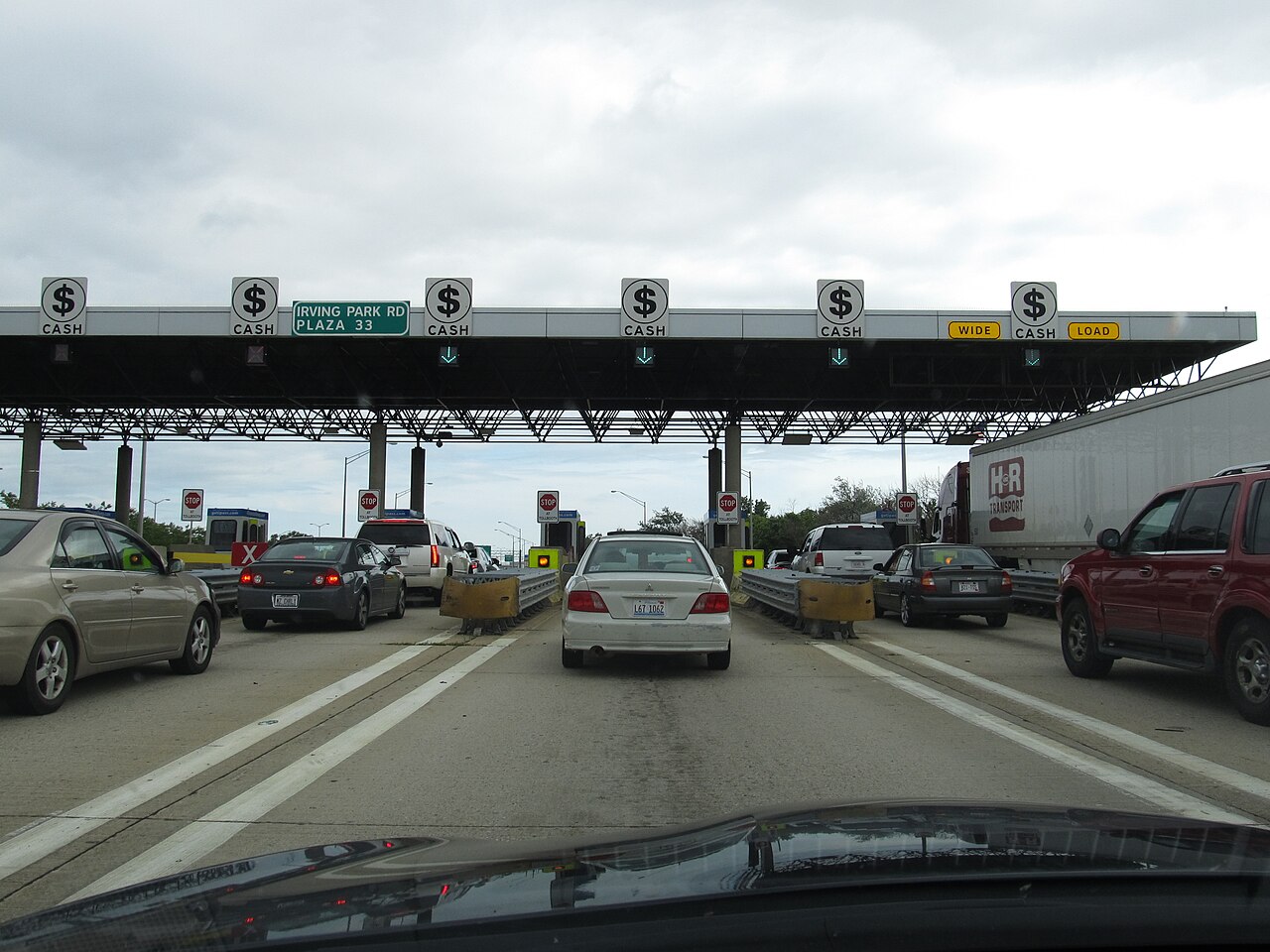
Last but not least, consider the sneakiness of tolls in Illinois. Before automated transponders for tolls, back in the days depicted in the image, we all knew how much we paid, whether it was giving our money to a toll-taker or tossing the exact change into a basket. Now our tolls are nearly invisible, with credit cards being replenished as needed, and with no signs showing how much was charged. Earlier in August, State Rep. Marty McLaughlin introduced the Truth in Toll Transparency Act to ensure drivers know their costs; the bill doesn’t yet have any co-sponsors.
Think about how many people don’t read the news, or if they do, don’t do so consistently. Having a toll/tax that is not posted, with an account that auto-replenishes is the same sort of trick that the government does over and over again, taxing businesses which are certain to pass the taxes on, or hiding taxes in other ways.
What’s it all add up to?
The goal of ending tolls is a long-term one, given Illinois’ current financial state. There are so many other issues the state needs to deal with first. But it was unconscionable that the state so arbitrarily boosted tolls for naked political reasons, and every legislator who voted for this should be called onto the carpet for that vote.
Will they say they had no choice, because party leadership bundled it in with a transit bill the details of which they had no control over? Then push them harder. They do not deserve a pass. Each legislator has a duty to govern responsibly and ethically, and that includes standing up to party leaders rather than meekly voting as they are told. The toll hike is one example, and there are countless more.