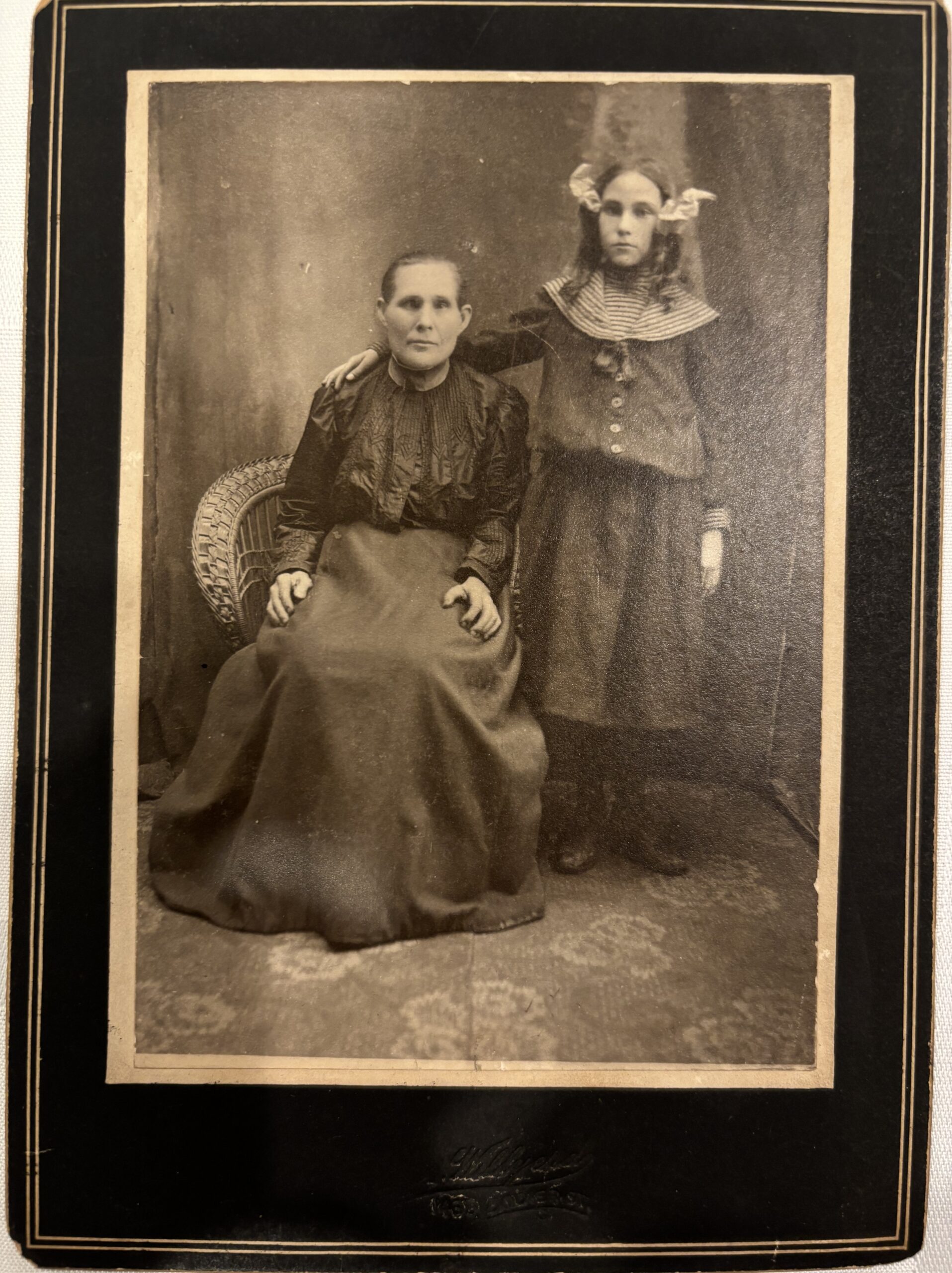
The photograph you see here has no date on it. On the back is written, “Amelia Wittkoetter[‘s] mother and sister Anne”; that’s my grandmother’s handwriting, and the photo is of her grandmother, also named Amelia Wittkoetter, and aunt. It’s clear that they are not well-off; the girl’s dress is ill-fitting, the woman’s hands are gnarled well beyond her years. Her crossed eyes suggest lack of money for eyeglasses. On the supposition that the girl is about age 11, the photograph was taken in about the year 1898, which would make the older Amelia about age 40.
By this point in her life:
She had immigrated from Germany in 1870, at about age 12, and settled in St. Louis, Missouri.
She had married once, had a child, then lost her husband to tuberculosis shortly before giving birth to her second child.
A little over a year later, she remarried, but was abandoned by her second husband before her third child was born.
A year after that, she began a common-law marriage with a third man, and in another year had another child.
The following year, she and/or her common-law husband attempted to abandon the child fathered by the deadbeat husband, leaving him in the the care of a man who Amelia claimed to be the actual father, but ultimately she retrieved her from the orphanage where she was left. (This is reported in the newspaper.)
Two years later, she lost her fifth child in infancy.
A further two years later, that is, the year prior to this photograph, she lost her sixth child in infancy and her common-law husband died of tuberculosis. She then supported the family by taking in laundry, and took in a divorced boarder, who may have actually been another common-law husband with a name that’s curiously similar to that of the man accused of fathering the briefly abandoned child.
Then in the following years, in 1906, her second-oldest child, Annie in the photograph, became a servant at age 19, and committed suicide two weeks into the job. (This is also reported in the newspaper.) Two years after that, Amelia died of pneumonia at the age of 50. Her remaining three children also become servants, then marry. One of the three loses her only child to prematurity. Another, my great-grandmother Amelia, the one who was once temporarily abandoned, married, was widowed, quickly remarried, and lost her firstborn, again in infancy, before finally finding stability and respectability in a sturdy blue-collar neighborhood prior to an untimely death at age 51 due to breast cancer.
This all took place in St. Louis. I would have liked to have used Google Street View to look at some of these many homes (because the family moved around quite a bit), but the only home that hasn’t been demolished is that of the family which employed the younger Amelia as a servant.
Now, at this point I could praise Amelia’s resilience but there’s no trace of that in the historical records, merely survival. I could celebrate her religious faith carrying her through the hard times, but despite the Lutheran tradition of infant baptism, the younger two daughters were unbaptized until the ages of 11 and 13.
Superficially there are similarities to the present day. The dysfunction of fathers abandoning their children or step-children, and unstable cohabitating relationships fueled by some combination of financial need and desire for companionship. Poverty. Mental health and suicide. Tenements with high infant mortality and epidemics then, neighborhoods with abandoned decaying houses or vacant lots now.
But it’s also important to mark Women’s History Month by recognizing the incredible improvements that have taken place in women’s lives, from medical advances to economic empowerment and a social welfare safety net. However much we might worry about finances or the job market or other issues, the magnitude of the struggles faced by women like Amelia is entirely different.
And beyond this, Women’s History Month is a time simply to know about the past, and the women whose harsh lives preceded our relative abundance.